
We’re updating our ticket sales system
rom 19 May 2026 onwards, all our tickets will be sold exclusively through ÅST’s own channels.
What happens when a book suddenly becomes a tent, a butterfly or something entirely different? For a young child, the line between reality and imagination is often blurred. Between the ages of two and five, children’s language, imagination and ability to interact with others develop rapidly. At the heart of it all is play – a child’s way of exploring and making sense of the world.
In Pjäsen om boken (The Play About the Book), we get to experience this very world, where an everyday object can transform into almost anything.
According to the Finnish National Agency for Education, play is central to children’s development, allowing them to explore both themselves and the world around them. By imitating others and playing together, children can experience and learn to recognise different emotions and qualities, such as disappointment and empathy. Play also helps children develop problem-solving skills and creative thinking.
In addition to helping children understand and manage their emotions and interact with others, play supports their physical and language development, including vocabulary, storytelling, body control and motor skills.
In Pjäsen om boken, the audience gets to experience the world from the perspective of children at play. Just as in real life, play is filled with joy, frustration and conflict.
As children grow older, they become increasingly able to understand what other people think and feel. Imagination develops rapidly between the ages of two and five, as children begin to engage in pretend play. During these years, they also develop the ability to engage in symbolic play – using one object to represent something entirely different. A pine cone can become a scoop of ice cream, a rug a spaceship, and a book a tent or a butterfly, just as in Pjäsen om boken. Through this kind of imaginative play, children can explore new possibilities and try out different roles.
Communication is about much more than words. Even before children can express themselves in complete sentences, they communicate through eye contact, gestures, facial expressions and movement.
Children aged two to three enjoy observing others and imitating what they see. They may play alongside one another, watch what the other child is doing and gradually begin to join in the same game. As children grow older, they also become better at cooperating, agreeing on the rules of play and creating shared stories that can change as the play unfolds.
In Pjäsen om boken, no spoken words are used. Instead, body language, movement and actions carry the story forward. Children are invited to interpret what happens on stage for themselves, just as they do when watching or joining in other children’s games. And the wonderful thing is that everyone doesn’t have to interpret what happens in the same way to share an experience together!
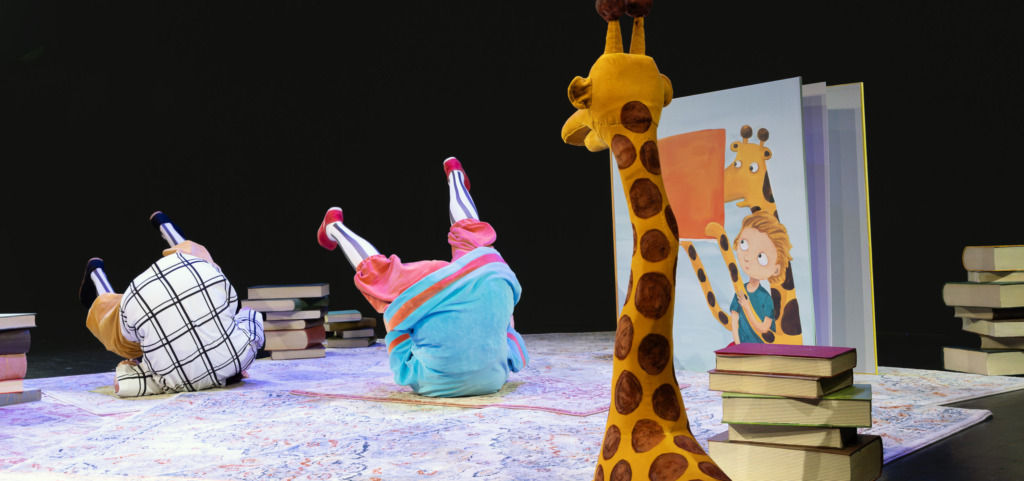
In Pjäsen om boken, children aged 2–5 can experience a story where words are not needed and a book can become almost anything.
Read more about the performance and book your tickets.
rom 19 May 2026 onwards, all our tickets will be sold exclusively through ÅST’s own channels.
When you, as a student, buy tickets to two performances at the same time – Åbo Svenska Teater’s Romeo and Juliet and Aurinkobaletti’s